Tony Alva - The Godfather of Skateboarding
How a kid from Santa Monica rewired what skateboarding could be
There's a version of skateboarding history that existed before Tony Alva, and a version that came after — and they barely resemble each other. That's not hyperbole. That's just what happened when a kid from Santa Monica started dragging surfing culture off the beach and into empty swimming pools, and in doing so, rewired what skateboarding could even be.
If you've been collecting long enough, you already know the name. But it's worth slowing down and really sitting with the story, because the further we get from the mid-70s, the easier it is to lose the texture of what that moment actually meant.
Dogtown Before It Was Dogtown
Tony Alva was born on February 2, 1957, in Santa Monica, California — practically on the doorstep of what would become the most important patch of concrete in skateboarding history. The area around Venice and Santa Monica's southern edge was a rough, sun-bleached stretch of beachfront that locals called Dogtown. It wasn't a brand yet. It was just where they were from.
By the early 70s, Alva was surfing and skating the area obsessively, part of a loose crew of kids who were being shaped — whether they knew it or not — by the particular energy of that place. The surf culture there was aggressive and territorial. It bled directly into how they skated. Low to the ground, fast, physical. Not the polished, competition-ready freestyle skating that dominated the era. Something rawer.
The anchor point for all of it was Jeff Ho Surfboards and Zephyr Productions, the surf shop in Venice co-owned by Jeff Ho and Skip Engblom. It was part shop, part cultural hub, and in 1975 it became the official home base for the Zephyr Competition Skate Team — the Z-Boys.
Del Mar, 1975
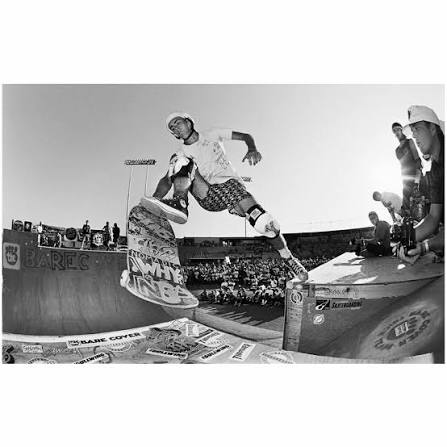
You want to talk about a moment that changed everything? April 1975, the Del Mar Nationals. The Z-Boys roll up and essentially make every other competitor look like they're skating in a different sport. While the rest of the field was doing the upright, technical freestyle routines that were standard at the time, the Z-Boys were low, aggressive, surfing the course. Craig Stecyk, who would go on to document the whole scene for Skateboarder Magazine, later described their approach as a collision between the street and the ocean.
The skateboarding establishment didn't know what hit them.
The team didn't sweep the podium. That's not really the point. The point is that every serious skater watching that contest walked away knowing that something had shifted. Alva was at the centre of it — his style already distinct, already completely his own.
The Drought That Built Vertical Skating
Here's the thing about history — sometimes it pivots on something completely mundane. In 1976, Southern California was in a serious drought. Homeowners drained their swimming pools. And the Z-Boys, Alva especially, started skating them.
Pool skating didn't just exist before this — it had been done. But what Alva and the crew brought to it was a level of commitment and progression that nobody had seen. They were treating the pool like a wave, carving the walls, riding higher and higher. Alva's surfing instincts were perfectly translated to the curved concrete. His crouching, flowing style looked like he was riding a big swell, not an empty backyard pool in someone's suburb.
Then, around 1977, it happened. Tony Alva became the first person documented to land a frontside aerial in a pool. He went above the coping. That's the moment where pool skating stops being an evolution of what came before and becomes something genuinely new. Airs. The vertical game. The foundation of what eventually becomes vert skating and, decades down the line, echoes in everything from street to park.
"He left the ground. That's when we knew." — the kind of thing that gets said quietly in back rooms among people who were there.
1977 — The Year That Defined Him
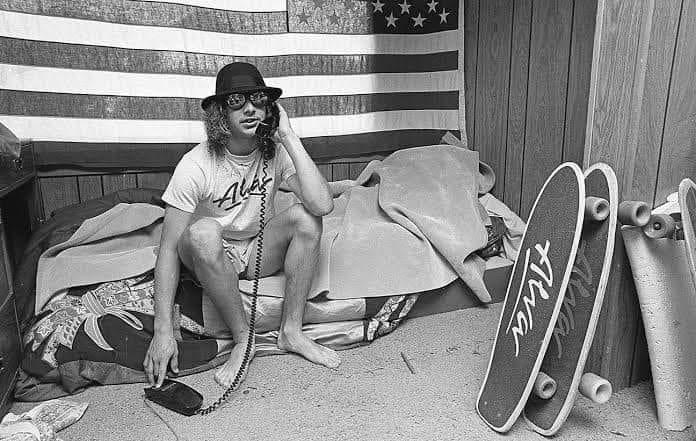
If you had to pick a single year for Alva, it's 1977, and it's not even close. He wins the World Freestyle Skateboarding Championship. He lands that first frontside aerial. He appears on the cover of Skateboarder Magazine in September — that cover is iconic, full stop, one of those images that defines an era. And he founds Alva Skates, his own company, making him one of the earliest pro skaters to own his brand outright.
Alva Skates, for collectors, is significant beyond the obvious nostalgia value. Founded in 1977, it is one of the oldest continuously operating skateboard companies in existence. The early boards — the shapes, the graphics, the team rosters — are a direct window into the period when skateboarding was figuring out what it was going to be. Boards from those early Alva runs don't come up often, and when they do, they go fast, because people understand what they're holding.
The Documentation
Part of why Alva's legacy has stayed so visible is that the Dogtown story got told well, and told twice. Stacy Peralta — himself a Z-Boys member — directed Dogtown and Z-Boys in 2001, a documentary that won both the Audience Award and the Director's Award at Sundance. It brought the whole story to a generation who'd grown up skating but maybe didn't know the deep roots. Then in 2005, Lords of Dogtown gave it the Hollywood treatment, with Victor Rasuk portraying Alva. The film is dramatised, obviously, but Rasuk captures something of Alva's magnetic, restless intensity.
Craig Stecyk's journalism in Skateboarder Magazine starting in 1975 was also crucial — it wasn't just coverage, it was mythmaking in real time, creating the narrative around Dogtown culture while it was still being lived. You can't fully understand the Z-Boys without understanding how Stecyk framed them for the world.
What He Left Behind
Jay Adams was the soul of the Z-Boys. Stacy Peralta was the technician. But Alva was the aggression, the ambition, the one who seemed to understand early that this thing they were doing was going to mean something lasting.
He kept Alva Skates running through the industry crash of 1980, when most companies folded and skateboarding went underground. That stubbornness, that refusal to walk away, is part of the legacy too. The company survived because he believed in it when the commercial logic said not to.
For collectors, Alva represents the ground floor. Not just of a company, but of a whole mode of skating — vertical, aerial, aggressive — that runs through everything that followed. When you're holding an original Alva deck, you're holding a piece of that first moment when a skater went above the coping and didn't come back down the same way.
The Dogtown era shaped what skateboarding became. And Tony Alva, more than anyone, shaped Dogtown.
1 person found this useful
Built for collectors like you.
Your collection deserves better than a spreadsheet.
Catalogue every board, log what you paid, and connect with collectors who get it. Your values are always private.