Skate Shoes: From Vans Authentics to the Collector Market
How a $4.49 canvas shoe became one of skating's most collectible artifacts

Skate shoes have always been more than footwear. They're rolling artifacts of where skateboarding was, who was pushing it forward, and what the culture valued at any given moment.
Vans launched in Anaheim in 1966 selling basic canvas deck shoes for $4.49, and within a decade those same silhouettes were being shaped by skaters into something no one had planned. Today, rare colourways and signature models from the 80s and 90s change hands for serious money among collectors who treat them the same way others treat vintage decks.
How Did a Basic Canvas Shoe Become Skateboarding's Uniform?
Paul Van Doren, his brother James, and Gordon C. Lee opened the Van Doren Rubber Company on March 16, 1966, at 704 East Broadway in Anaheim, California. They made shoes on-site and sold direct. Simple as that.
The original deck shoe - Style #44, later renamed the Authentic in 1993 - cost $4.49 for men. It wasn't designed for skating. Skaters just found that vulcanised rubber sole gripped griptape better than anything else on the market, and the low profile let them feel the board. They adopted it. Vans didn't chase them. The skaters came first.
By the mid-1970s, Vans took that relationship seriously. They collaborated with Tony Alva and Stacy Peralta to create the Era - originally called the "Off the Wall" shoe - their first shoe built specifically for skating. Padded collar, better ankle support, same sticky sole. It made sense for the pool-skating era when you were grinding concrete coping in the California sun.
The Moments That Made Vans Iconic
The 1977 Old Skool is where things got interesting from a design standpoint. Originally Style #36, it was the first Vans to feature the side "Jazz Stripe." That wavy line is so embedded in visual culture now that it barely registers as a logo anymore. It just reads as Vans.
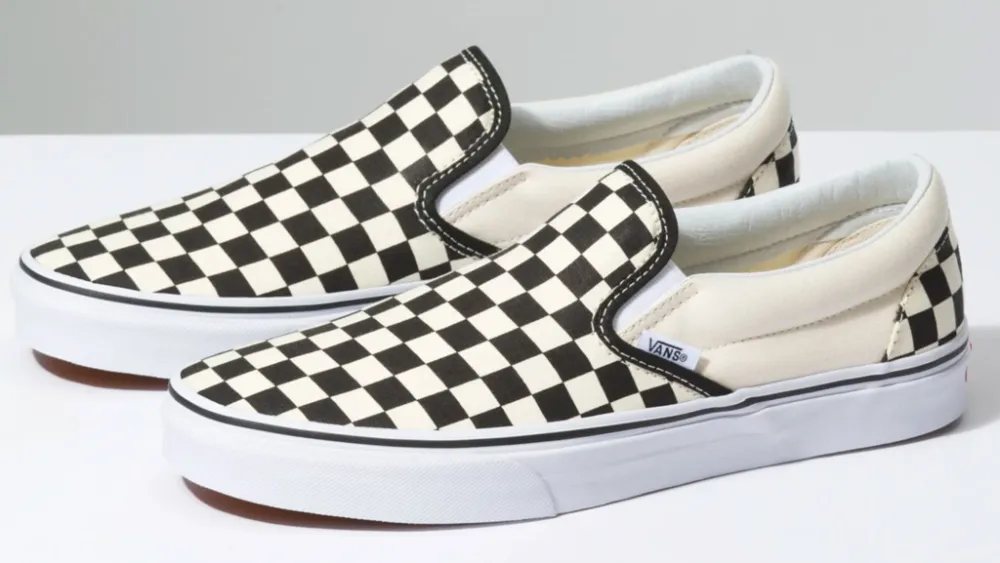
Then came 1982 and Sean Penn wearing checkerboard Slip-Ons as Jeff Spicoli in Fast Times at Ridgemont High. That film did for Vans what Back to the Future did for Nike. Overnight, a skate shoe became a symbol of a whole American youth attitude. Kids who'd never touched a skateboard were buying them.
I remember seeing checkerboard Vans in Australian surf shops in the mid-80s. The connection to actual skating was already blurring, but that exposure brought new kids to the skate shop, and some of them stuck around.
The Half Cab and Why Skaters Still Tell That Story
The Half Cab, released in 1992, is one of the better pieces of skate shoe folklore. Street skaters had been physically cutting down Steve Caballero's original high-top signature shoe - released in 1989 - into a mid-top because the full height got in the way of technical tricks. Vans watched what skaters were doing and made it an official model.
That's the story the culture loves. The shoe didn't come from a marketing team. It came from skaters with scissors. Caballero's second signature model became one of the most enduring skate shoes ever made, and it started because someone decided to hack up their shoes.
What Do Collectors Actually Chase?
The collector market for skate shoes has grown steadily alongside the broader sneaker market, but it operates differently. Skate shoe collectors tend to care about provenance and era more than limited drops.
The pieces that move are usually:
- Deadstock 80s and early 90s Vans in original colourways, unworn, with original box
- Early pro signature models from skaters who had cultural weight - Caballero, Hosoi, Hawk
- Collabs with small skate brands from the late 90s and early 2000s before the category got corporatised
- Regional colourways that were only released in certain markets - these are genuinely rare
The global skate shoe market was valued at $970 million in 2024 and is projected to reach $1.48 billion by 2033. That's a 5.2% CAGR. The collector end is a small slice of that, but it's the slice that holds cultural memory.
VF Corporation acquired Vans in 2004 for roughly $396 million, paying $20.55 per share. That acquisition marked the point where Vans was undeniably a global brand operating at scale. For collectors, pre-acquisition era product has a different feel - literally and figuratively.
Is the Collector Market for Skate Shoes Legit?
Compared to vintage decks, skate shoes haven't fully arrived as a collector category with standardised grading and pricing. But it's moving that way. Condition matters enormously - deadstock means deadstock, not "barely worn." Original box, original insoles, original laces. Those details separate a $40 thrift find from a $400 collector piece.
Authenticity is the other issue. Vans in particular has been produced in such volume across so many eras that you really need to know your manufacturing details - country of origin stamps, sole construction, tongue labels - to verify what you've actually got.
It's a similar skill set to identifying a genuine vintage deck versus a reissue. The knowledge pays off.
The Quick Version
- Vans was founded March 16, 1966, in Anaheim, California, and started selling basic canvas deck shoes for $4.49
- Skaters adopted Vans organically before Vans actively pursued the skate market - the Era in the mid-1970s was their first purpose-built skate shoe
- The Half Cab (1992) came directly from skaters cutting down the high-top Caballero model - Vans turned their modification into an official silhouette
- Deadstock 80s and early 90s Vans command the most serious collector attention, with condition and original packaging being the key value factors
- The skate shoe market sits at $970 million globally and is growing - the collector segment is still maturing but the interest is real and increasing
Find this useful?
Built for collectors like you.
Your collection deserves better than a spreadsheet.
Catalogue every board, log what you paid, and connect with collectors who get it. Your values are always private.