Jim Phillips: The Artist Behind the Most Valuable Skate Graphics
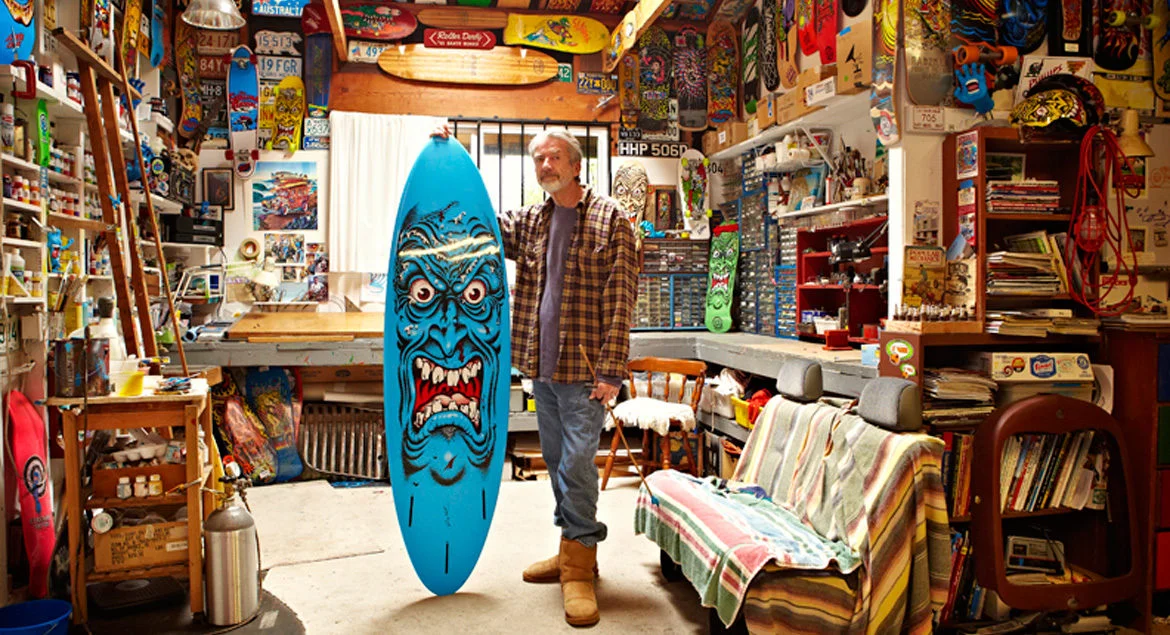
Jim Phillips is the reason skateboard graphics became art. More than any other single artist, his work at NHS Inc. through the late 1970s, 80s, and into the 90s defined what a skateboard was supposed to look like - and the decks he created are now among the most sought-after pieces in skate collecting.
Jim Phillips joined NHS Inc. (the parent company of Santa Cruz Skateboards) as staff artist in 1975 and spent over three decades creating graphics that shaped skate culture globally. His Screaming Hand, created in 1985, is one of the most reproduced images in skateboarding history. Original vintage pro model decks bearing his work regularly sell for $500 to over $3,000 depending on rarity and condition.
Why Does Jim Phillips Matter So Much?
Born in Santa Cruz in 1944, Phillips wasn't a skater who learned to draw. He was a trained artist - studied at Cabrillo College in Santa Cruz - who threw himself completely into the world of skateboarding when NHS came calling. That outside-in perspective is part of what made his work so striking. It didn't look like anything else.
Santa Cruz Skateboards was founded in 1973 by Richard Novak, Doug Haut, and Jay Shuirman - NHS standing for their surnames. By the time Phillips came on board in 1975, the company was building toward something. He gave them a visual identity that outlasted every trend.
What Made His Style Recognisable
The work is visceral. Bold linework, horror-influenced figures, a kind of controlled chaos that felt dangerous and fun at the same time. It matched what skateboarding actually was in the 80s - loud, a bit threatening to mainstream sensibilities, undeniably alive.
The Screaming Hand from 1985 is the obvious centrepiece. A hand with eyes, screaming, dripping, instantly readable from across a car park. It became the Santa Cruz Slasher logo and took on a life entirely separate from skateboards - appearing on apparel and stickers in millions of units worldwide. Forty-one years later, it's still everywhere.
The Rob Roskopp Face series, also 1985, followed a similar logic. Grotesque, memorable, impossible to mistake for anything else. These weren't designs you forgot.
The Decks That Collectors Actually Want
Phillips worked with some of the best street and vert skaters of the 80s, and those collaborations produced the boards collectors obsess over today. A few specific graphics come up again and again in serious collections.
The Natas Kaupas panther model from 1987 is probably the most talked-about. Natas was doing things on the streets of LA that nobody had seen before, and the panther graphic matched the energy perfectly - wild, sleek, a little unhinged. Finding an original in any real condition is genuinely difficult.
The Jeff Kendall End of the World deck from 1988 hits another level. Near-mint originals have sold for over $2,000 at auction. The graphic itself is classic Phillips - apocalyptic, dense, weirdly beautiful.
Steve Olson and Jason Jessee models from the same era are also consistently sought after. Any original Jim Phillips pro model from the 1985-1989 window is worth paying attention to.
| Deck | Year | Condition | Approximate Value |
|---|---|---|---|
| Natas Kaupas Panther | 1987 | Good | $800 - $1,800 |
| Jeff Kendall End of the World | 1988 | Near-mint | $2,000+ |
| Rob Roskopp Face (any issue) | 1985 | Good | $500 - $1,200 |
| Jason Jessee Sun God | Late 80s | Good | $600 - $1,400 |
| Steve Olson Dragon | Late 70s/early 80s | Good | $400 - $900 |
These are auction and private sale reference points. Condition is everything - a chipped nose and missing grip tape will cut the value significantly.
Reissues: Good for Skating, Different Story for Collecting
Santa Cruz started releasing reissue decks of classic Phillips graphics from around 2008 onwards. They're well made and accessible, and honestly a great way to ride a piece of history without destroying something irreplaceable.
But they're not the same thing for collecting purposes. Originals have the wear patterns, the old school dimensions, the specific screen printing of the era. Reissues are clearly marked as such and have their own modest collectibility in time, but nobody's paying $2,000 for one right now.
If you're buying to collect rather than skate, learn to tell them apart before spending serious money.
The Family Business
Phillips wasn't the only one. His son Jimbo Phillips grew up inside that world and became a professional skate graphic artist in his own right - continuing to produce work for Santa Cruz and other brands. The visual language Jim built has been extended and evolved by Jimbo across the 2000s and 2010s.
There aren't many father-son stories quite like it in skateboarding. One of them built the whole visual identity of an era. The other kept it going.
The Cultural Weight
In the 2020s, Jim Phillips graphics started appearing in museum exhibits on skateboarding culture and art. That's not nothing. For a long time, skate graphics were dismissed as commercial ephemera. Now they're being treated as what they actually were - significant visual art produced at the intersection of youth culture, commerce, and genuine creative talent.
Phillips did that. The graphics held up because they were good, not just familiar.
The Quick Version
- Jim Phillips joined NHS Inc. in 1975 and spent over three decades as the visual architect of Santa Cruz Skateboards.
- The Screaming Hand (1985) is the signature work - one of the most reproduced images in skateboarding history, still globally recognised 41 years on.
- The most valuable original decks come from the 1985-1989 window: Natas Kaupas panther, Jeff Kendall End of the World, Rob Roskopp Face series.
- Near-mint originals can reach $2,000 to $3,000+ at auction. Condition and authenticity are everything.
- Reissues exist from 2008 onwards - legitimate and well made, but a different category for serious collectors.
Find this useful?
Built for collectors like you.
Your collection deserves better than a spreadsheet.
Catalogue every board, log what you paid, and connect with collectors who get it. Your values are always private.