Cataloguing Your Skate Collection: Why It Matters and How to Do It Right
A practical guide to documenting what you own, protecting what it's worth, and building records that hold up.
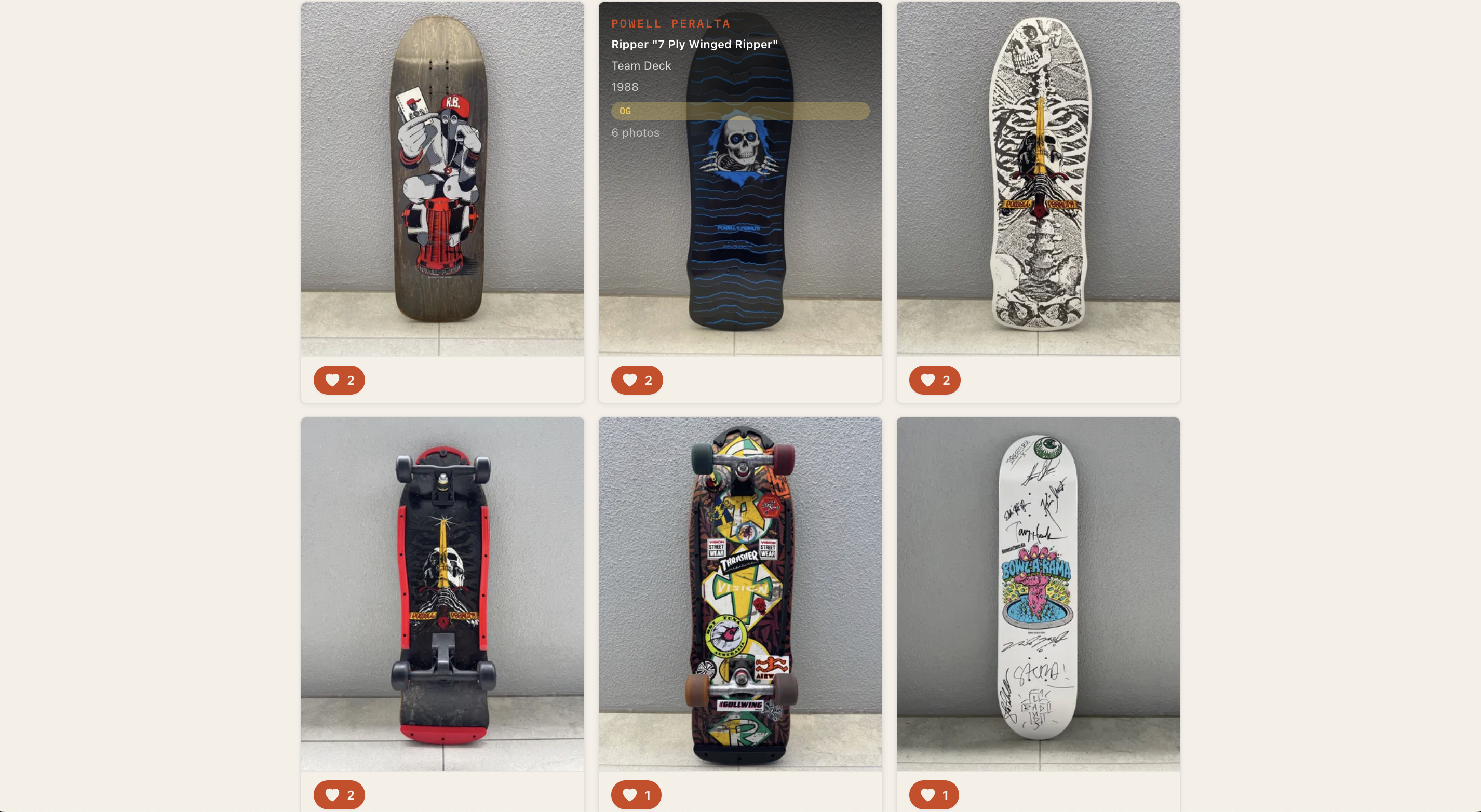
If you're serious about collecting vintage skate decks, cataloguing your collection isn't optional. It's the difference between knowing what you've got and just hoping for the best when it comes time to insure, sell, or prove provenance.
Properly cataloguing a skateboard collection protects your financial investment, helps authenticate pieces, and builds a documented record that pays off at resale or insurance time. Most collectors wait too long to start, and that's a mistake that's hard to fix retroactively.
Why Does Cataloguing a Skate Collection Actually Matter?
A documented collection is worth more than an undocumented one. Full stop. Buyers, insurers, and auction houses all respond to evidence. A Powell Peralta Bones Brigade deck from the mid-80s might fetch anywhere from $500 to $3,000-plus at auction, but that range is heavily influenced by what you can prove about its history and condition. Without a catalogue entry, you're just guessing.
I've seen collectors lose real money at resale because they had no baseline documentation. A mint Rick Hosoi Hammerhead from 1988 sold for over $2,500 at Heritage Auctions. Try claiming that kind of value on an insurance form without supporting records.
What Should a Catalogue Entry Actually Include?
Each entry needs to capture enough detail that someone who's never seen the board can understand exactly what it is. That means:
- Brand and model name (e.g. Powell Peralta Steve Caballero Dragon/Yin-Yang)
- Year of production (use hardware, graphics, and catalogue references to pin this down)
- Colourway (this matters enormously for value - same deck, different colour can mean hundreds of dollars)
- Condition grade on the 1-10 scale used across the hobby, with NOS at the top
- Dimensions (width, length, wheelbase if measurable)
- Hardware present and whether it's period-correct (Tracker Trucks and Independent Trucks have logo variations across decades that help date builds)
- Provenance notes - where you got it, when, what you paid
- Photo references (minimum four angles: face, back, nose, tail)
- Comparable sales at time of acquisition
That last one is easy to skip but worth doing. eBay has created price transparency in this market since 1995. Take ten minutes when you acquire a piece and screenshot relevant sold listings. Future you will thank current you.
How Do You Grade Condition Consistently?
Skateboard collecting uses a 1-to-10 condition scale, borrowed loosely from trading card grading. Here's a quick reference for where most vintage decks sit:
| Grade | Description | Example Value Impact (mid-80s PP deck) |
|---|---|---|
| 9-10 (NOS) | Unridden, original shrink or store stock | $2,000 - $3,000+ |
| 7-8 (Near Mint) | Minimal handling, no ride wear | $1,000 - $2,000 |
| 5-6 (Very Good) | Light shelf wear, minor edge rubs | $400 - $900 |
| 3-4 (Good) | Visible wear, intact graphic | $150 - $400 |
| 1-2 (Poor/Ridden) | Heavy wear, faded or damaged graphic | $50 - $150 |
The Steve Caballero Dragon/Yin-Yang deck from 1985 is a useful benchmark. It comes up at auction often enough that you can cross-reference your grade against real-world results. Same goes for Tony Hawk Powell Peralta decks from 1983 to 1991 - the market for those is active enough that comparable sales are easy to find.
Be honest with your grades. Overclaiming condition is the fastest way to burn your credibility with other collectors or buyers.
What Tools Should You Actually Use?
This is where most collectors go wrong. They start with a notes app or a spreadsheet, add a few entries, and then let it slide. Six months later they've got 30 boards and half-arsed records on maybe ten of them. That's almost worse than nothing.
A generic spreadsheet can work as a starting point. But it doesn't handle photos well, it doesn't track value over time, and it's not built around the way skateboard collectors actually think about their collections. You end up spending more time fighting the tool than using it.
Skateboard Stash was built specifically to solve this. Photo storage, condition tracking, value records in multiple currencies, and a community of collectors who actually know what a 1985 Caballero is worth. If your collection is serious enough to catalogue properly, it's worth using something designed for the job. There's a free tier if you want to try it before committing.
Whatever you use, pick one system and stick to it. Half-catalogued collections are almost as bad as none at all.
What Primary Sources Should You Reference?
Cross-referencing your catalogue against primary sources is what separates serious collectors from casual ones. Early issues of Thrasher - the first one hit in January 1981 - are genuine research documents. Period skateboarding zines from the 1970s, valued at $20 to $150 per issue depending on rarity, contain original product advertising that helps date and authenticate hardware.
Brand catalogues are gold. NHS Inc., founded in Santa Cruz in 1973, produced Santa Cruz catalogues across the decades that list colourways, dimensions, and production years. Powell Peralta's own advertising from 1978 onward is well archived online. These aren't just interesting reading - they're authentication tools.
What Are the Most Common Cataloguing Mistakes?
Not photographing before cleaning or restoration. Always shoot the board in found condition first. That documentation is irreplaceable.
Ignoring hardware. A period-correct complete is worth significantly more than a deck with wrong-era trucks. Catalogue the hardware separately with its own dating notes.
Vague provenance. "Got it at a swap meet" is better than nothing but not by much. Names, dates, locations, and paper trails add real value.
Letting it pile up. Every board you acquire without cataloguing immediately is a future headache. Do it the day it arrives.
The Quick Version
- A catalogued collection is a protected investment - condition grades, provenance, and comparable sales all directly affect resale and insurance value
- Use the 1-10 condition scale consistently - benchmark against well-known pieces like the 1985 Caballero Dragon/Yin-Yang or 1983-1991 Tony Hawk Powell Peralta decks
- Document hardware separately - Tracker and Independent truck logo variations are dating tools, not just extras
- Primary sources matter - Thrasher issues, brand catalogues, and period zines are authentication references, not just collectibles
- Purpose-built beats generic - a tool designed for skateboard collectors will serve your collection better than a spreadsheet you'll abandon in three months
Frequently Asked Questions
Do I need to catalogue boards I bought just to skate? If they're vintage pieces with any collector value, yes. You might not plan to sell, but circumstances change. A quick entry takes ten minutes and protects you.
How do I handle boards I acquired years ago with no documentation? Start where you are. Photograph them now, grade them honestly, and note what you do know about acquisition. Partial records are better than nothing, and some provenance can be reconstructed through receipts, messages, or seller memory.
Is it worth cataloguing hardware and wheels separately from decks? Yes, especially for complete builds. Period-correct hardware like Tracker Trucks or early Independent variants adds real value to a complete and should be documented independently.
What if I disagree with my own earlier condition grade? Update it with a date and a note explaining the revision. A catalogue with honest revisions is more credible than one that never changes.
How do I value pieces for insurance purposes? Use recent comparable sales from eBay sold listings, Heritage Auctions results, and community price guides. Screenshot your sources and attach them to the relevant catalogue entry. Update annually if the piece is significant.
Find this useful?
Built for collectors like you.
Your collection deserves better than a spreadsheet.
Catalogue every board, log what you paid, and connect with collectors who get it. Your values are always private.